How to Build a Complete Game Plan in 10 Minutes with AI
Tuesday night. Your next game is Friday. You've got the opponent's last six box scores uploaded from last week's tournament. Your coaching style profile is set — motion offense, man-to-man, crash the glass. Your roster metrics are current from last month's combine testing.
The game plan is already sitting inside your data. You just need something to pull it together.
That used to take three hours on a whiteboard. A legal pad, a stack of printed stat sheets, and a pot of coffee. By the time you were done, you'd burned an entire evening building it.
What if the scouting you've already done built the game plan for you?
Everything the Game Plan Needs Already Exists
Most coaches treat game planning as a blank-slate creative exercise. Start from nothing. Build from scratch. Every week, the same grind.
But if you've been using XCIV.ai — even for a few weeks — the inputs are already in the system.
Your coaching style profile tells the AI how you want to play. You set it once during onboarding: motion offense, drive-and-kick; man-to-man base, pack the paint; eight-man rotation, tighten in crunch time. The AI doesn't generate a generic game plan and hope it fits your system. It starts from your system and builds outward.
Your roster metrics tell the AI what your players can do. Combine-day measurements — vertical, wingspan, lane agility, sprint times — plus skill benchmarks and development tracking. When the AI assigns a defensive matchup, it's referencing actual physical data, not guessing based on jersey numbers.
Your opponent data tells the AI what you're facing. Every box score you've uploaded, every stat sheet you've parsed, every opponent profile you've built. Scoring tendencies, turnover rates, key player breakdowns — already structured and waiting.
The game plan isn't a creative act. It's a synthesis — your philosophy, your roster, and your opponent's data, assembled into a single document. The AI just does the assembly faster than you can. It's the biggest reason coaches pick XCIV.ai as a Hudl alternative — Hudl shows the film; this builds the plan.
If you've already scouted the matchup, the hardest part is done.
One Command. Three Outputs.
Navigate to your upcoming game. Tap "Prep This Game." The system runs a pre-flight check — a quick scan of what data it has on this opponent.
In two or three seconds, you see an inventory: six box scores from this season, roster on file, no previous matchup history, no coach notes. Every item gets a status — green for good, yellow for limited, red for missing. Nothing is a hard blocker; the AI works with whatever you have. Want to add a box score or drop a quick note ("they just switched to zone")? Do it before the run starts.
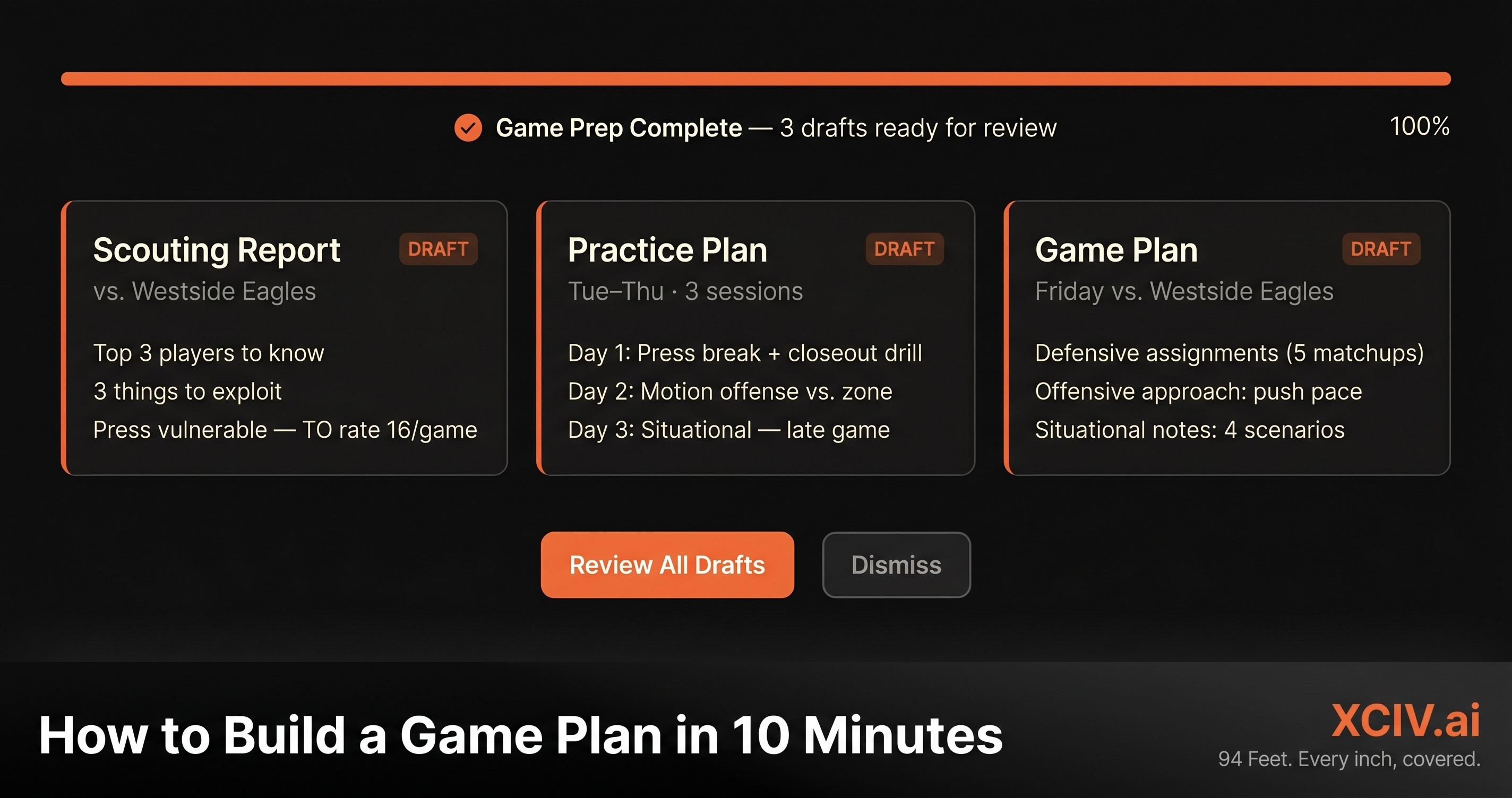
Tap "Run With What We Have." About ninety seconds later, the system delivers three draft outputs — all built from the same deep analysis of your coaching style, your roster, and the opponent:
- A scouting report — opponent snapshot, top three players to know, how they play, and three specific things your team can exploit. One page, scannable, every claim backed by a stat.
- A practice plan — a day-by-day breakdown from now until game day, every drill tied to something in the scouting report.
- A game plan — defensive assignments, offensive approach, situational notes, built from everything above.
All three reference the same analysis. All three are filtered through your coaching philosophy. And all three are drafts — ready for you to review before anything goes live.
What a Game Plan Actually Looks Like
The game plan output isn't a wall of text. It's structured for the way coaches actually use it — on a phone at 10pm, printed for the bench folder, or handed to an assistant fifteen minutes before tip.
Matchup assignments come first. Not "guard their best scorer" — that's obvious. Instead: "Your #5 (best perimeter defender, 4.8 lane agility) on their #23 (18.4 PPG, creates off the dribble). Contest everything — he's 28% on contested threes vs. 52% open." That recommendation exists because the AI cross-referenced your roster's physical metrics against the opponent's scoring patterns. It's not a guess. It's a data-informed matchup.
Defensive and offensive game plans follow — specific rules tied to specific personnel. Stay attached to #23 off screens. Help one pass away from their post — he's not a passer. Run early offense; they don't get back in transition. Situational notes cover the moments that decide close games. Every line references a specific stat, a specific player, a specific matchup. Nothing generic. Nothing the AI couldn't back up with data.
Review, Edit, Own It
Here's the part that matters most: you don't publish anything you haven't reviewed.
All three outputs arrive as drafts. They sit in a review queue — not on your public game page, not visible to your staff. Open any one. The editor is the same one you'd use if you'd built the plan from scratch — same fields, same formatting, same print layout. The AI gave you a head start; now you make it yours.
Change a matchup assignment. Swap a drill. Add a situational note the AI couldn't know — "their point guard tweaked his ankle Tuesday, test him early." The AI assembled your data; you add the coaching instincts no model can replicate. When you're satisfied, tap approve. It shows up in your game plan list alongside every plan you've ever built manually — same list, same editor, same export.
The AI wrote the first draft in ninety seconds. You reviewed and refined it in five minutes. Three hours of whiteboard work, replaced by a ten-minute review of a document your own data already knew how to write.
The Plan Feeds Everything That Follows
The game plan doesn't exist in isolation. The practice plan that shipped alongside it is built from the same scouting analysis — every drill maps to a tendency the AI identified in the opponent data. Your players aren't running generic practices this week; they're preparing for this specific game.
And when Friday night ends, the cycle restarts. Upload tonight's box score, the opponent profile updates, your roster metrics get a new data point. The next time you face this team, the scouting is deeper, the matchups sharper, and the game plan smarter.
Scout → Plan → Practice → Execute. And then scout again. That's not a game plan. That's a coaching system that compounds every time you use it.
XCIV.ai is the coaching workflow platform for high school, AAU, and club basketball coaches. Start free — your coaching profile, your first opponent, and your first AI game plan are included on the Starter tier.
94 Feet. Every inch, covered.
XCIV.ai gives every coach a scouting room, a practice planner, and a game plan engine.
Start Free