From Box Score to Game Plan: A High School Basketball Scouting App Walkthrough
You're sitting in the stands at a Tuesday night game, watching the team you play Friday. You've got a napkin, your phone's notes app, and about 32 minutes before halftime.
You came to scout. What you walk out with — a box score, some scribbled observations, maybe a few voice notes — has to become a game plan by Thursday afternoon.
This is the most common scouting situation in high school basketball. No Synergy subscription. No analytics department. Just you, a box score, and what you saw. This walkthrough shows you exactly how to turn that into a complete game plan using a high school basketball scouting app built for this workflow — start to finish, under 30 minutes.
Step 1: What You Can Pull from a Box Score Alone
Most coaches underestimate how much information is in a box score before they've analyzed a single clip.
A box score gives you:
Scoring distribution. Who's carrying the load? If one player has 24 of their 58 points, your defensive game plan starts there. If scoring is spread across five players, you're dealing with a balanced attack that punishes help defense.
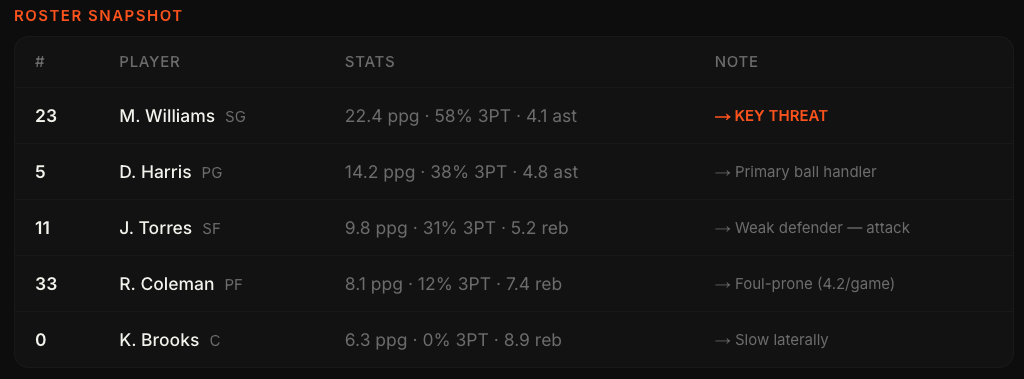
Foul trouble patterns. A starter with 4 fouls in 22 minutes tells you something about their aggression, their defense, and how their coach manages them in pressure situations. That's exploitable.
Rebounding margin. Teams that dominate the offensive glass run second-chance offense. That's a specific defensive adjustment — hard box-outs, no gambling on steals — that should show up in your game plan.
Tempo indicators. Total possessions (estimate it from field goal attempts + turnovers) tells you whether you're facing a pace team or a half-court grinder. Your offensive preparation looks different for each.
Free throw rate. A team that gets to the line 30 times a game is aggressive and physical. That's a foul management issue for your bench players.
Before you've watched a single clip, you have the outline of a scout.
Step 2: Layer in Your Live Observations
The box score is the skeleton. Your live observations from the stands are the substance.
When you're scouting in person, you're watching for things the box score can't capture:
- How do they initiate offense? Pick-and-roll heavy? Dribble-drive? Post-entry?
- What does their transition offense look like — push it every time, or walk it up?
- How do they guard ball screens? Hedge and recover? Switch? Drop?
- Who are the shot-makers vs. the role players? Which guys stop the ball with their dribble?
- Are there tendencies under pressure — late-game ATO plays, timeout sets, how the point guard responds to a trap?
You don't need to capture everything. Five or six sharp observations layered onto the box score data is enough to build a real scout. The goal is specificity, not volume.
Step 3: Build the Game Plan with AI
This is where the workflow changes. Instead of spending Wednesday night retyping notes into a Word doc, you feed what you have into XCIV.ai and get a working draft back in minutes.
Here's the actual input that generates a useful output:
"Scouting report: Friday opponent runs dribble-drive heavy offense, their #11 (6'2" SG) is their primary creator — 22 PPG, gets to the line constantly. They like to push in transition off misses. Half-court they run a lot of Spain pick-and-roll, sometimes curl cuts off a staggered screen. Defensively they play man-to-man, switch 1-4, tend to give up baseline drives. Rebounding: they dominate the offensive glass (+9 per game). My team: we're a half-court team, better when we slow the pace. Our strength is post play and mid-range shooting from the elbows. Build me a defensive game plan focused on taking away #11 and limiting second-chance points, plus an offensive approach to exploit their baseline gap and play through our bigs."
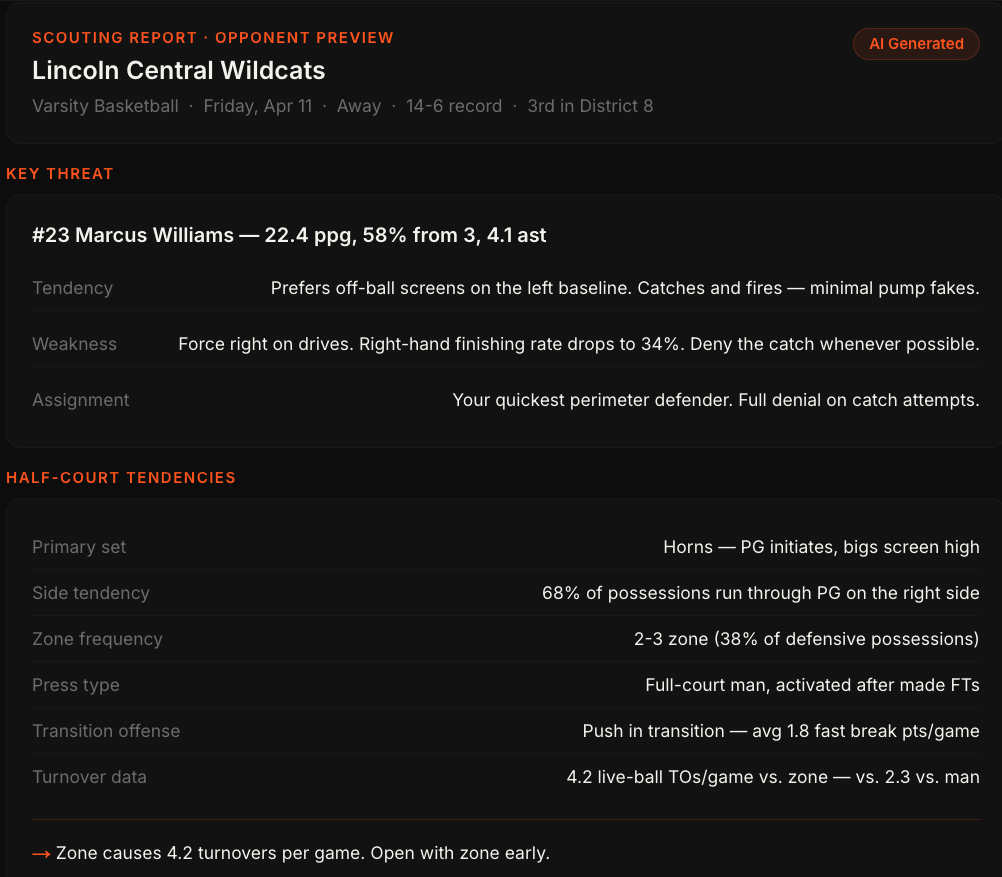
That input — built from the box score analysis in Step 1 and your live observations in Step 2 — generates a complete game plan: defensive assignments, help rotations, rebounding emphasis, offensive actions to install, and coaching points your assistants can actually use.
It's not a generic template. It's built from what you told it about this specific opponent against this specific team.
Step 4: Build the Practice Plan Around the Scout
A game plan is only as good as your preparation to execute it. Once the scout is built, the next question is: what do we practice Thursday?
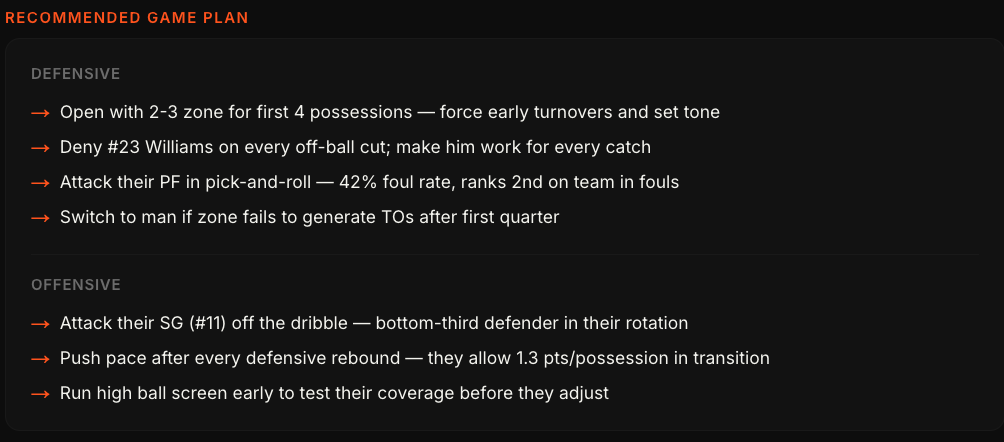
With AI, this step is fast. Feed the game plan back in with your available practice time and get a structured practice plan — drill sequence, timing, coaching points — organized around the defensive and offensive concepts you just built.
- 15 minutes on shell drill vs. dribble-drive with emphasis on no-help-unless-ball-is-in-paint
- 10 minutes on your box-out coverage scheme
- 20 minutes on your two offensive actions to exploit their baseline gap
- Film session walkthrough: five clips of #11, three clips of their Spain P&R, two clips of their ATO
That's a practice built specifically to win Friday's game. Not a generic practice. Not a template.
The Full Workflow, Condensed
Here's the complete box-score-to-game-plan sequence:
- At the game: capture box score + 5–6 live observations (written or typed into your phone)
- At home (10 min): analyze box score for scoring distribution, tempo, foul patterns, rebounding
- In the scouting app (10 min): input opponent profile + your team's strengths, generate game plan
- Review and adjust (5 min): refine based on what you know about your own personnel
- Practice planning (5 min): generate Thursday's practice plan directly from the game plan
Total time from scouting to executable plan: under 30 minutes.
For coaches running their program alone — or with one assistant — that's the difference between showing up to Thursday practice prepared and showing up hoping it comes together.
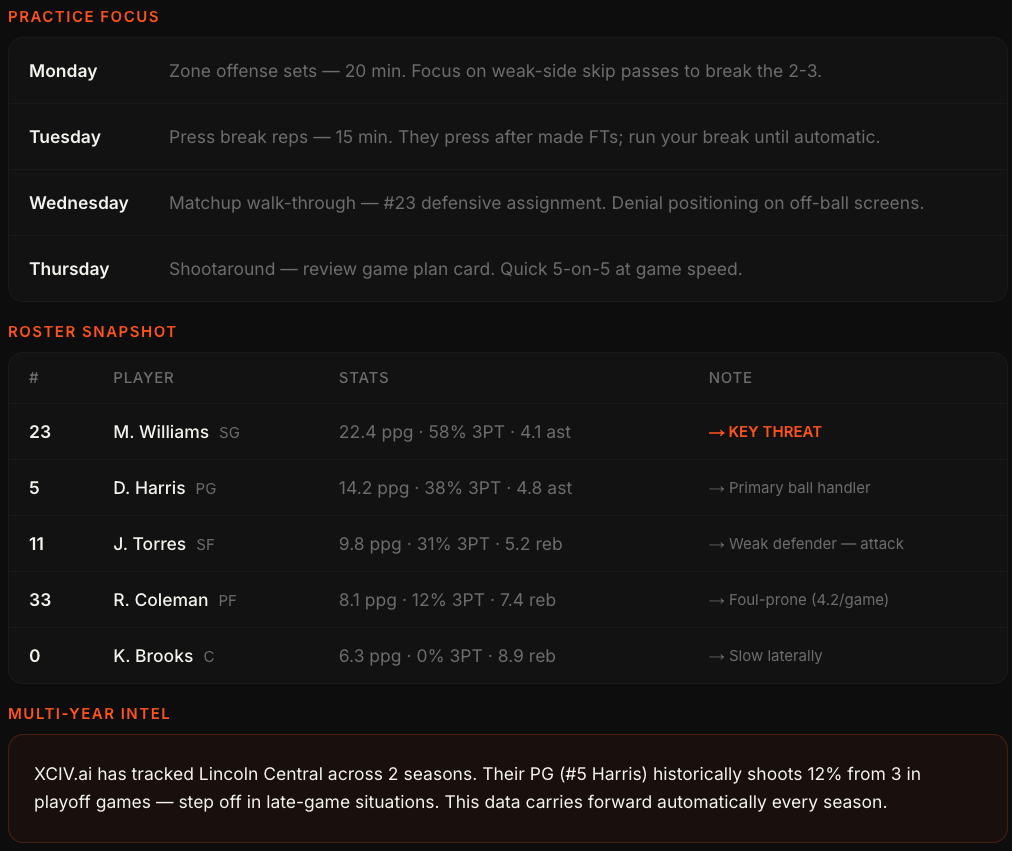
XCIV.ai is the high school basketball scouting app built for this exact workflow. Upload your next box score — free Starter tier, no credit card required. Start building your first game plan →
If you're comparing tools before you commit, see how XCIV.ai stacks up against Hudl and why most high school coaches end up using both.
94 Feet. Every inch, covered.
94 Feet. Every inch, covered.
XCIV.ai gives every coach a scouting room, a practice planner, and a game plan engine.
Start Free